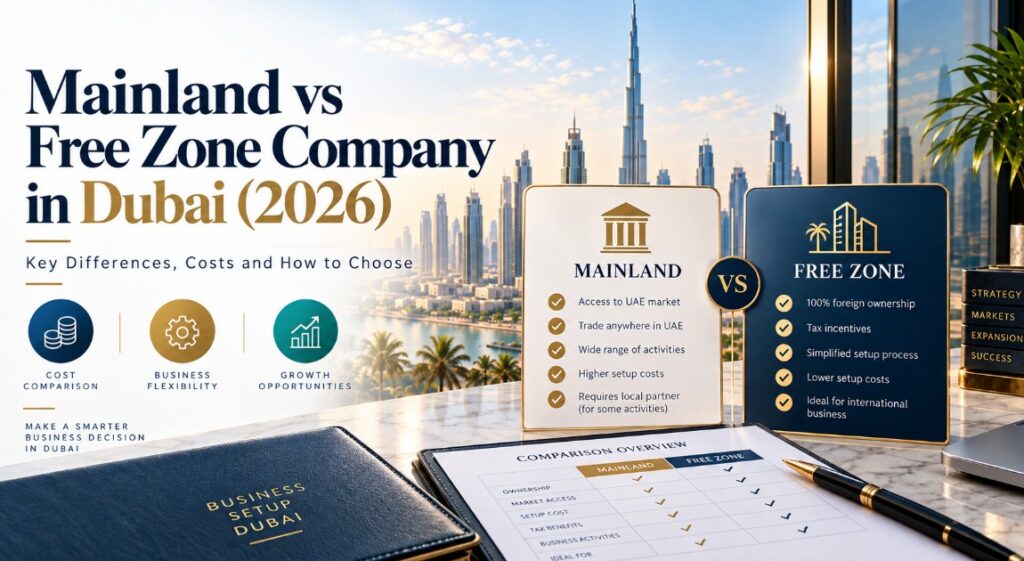
Mainland vs Free Zone Company in Dubai (2026): Key Differences, Costs and How to Choose
Quick Answer: The main difference between a mainland and a free zone company in Dubai is market access. A mainland company, licensed by the Department of Economy and Tourism (DET), can trade directly with customers anywhere in the UAE and bid for government contracts. A free zone company, licensed by a free zone authority such as IFZA, DMCC or Meydan, trades within its zone and internationally, and needs a distributor, branch or DET permit to sell on the mainland. Both now allow 100% foreign ownership for most activities. Free zones usually cost less to start (from around AED 12,500), while mainland setups typically cost more because of office and Ejari requirements. According to NEXORA Business Consultancy, the right choice depends mainly on where your customers are.
Key Takeaways
- Market access: Mainland = direct access to the whole UAE market. Free zone = international and in-zone trade, with mainland access through approved routes.
- Ownership: 100% foreign ownership is available in both for most activities since the 2021 reforms.
- Cost: Free zone packages start from around AED 12,500; mainland setups usually run AED 25,000–60,000+ in year one.
- Office: Free zones offer flexi-desks and zero-visa options; mainland companies need registered premises with Ejari.
- Tax: Mainland companies pay 9% corporate tax on taxable income above AED 375,000. Qualifying free zone companies can pay 0% on qualifying income, with 9% on non-qualifying income.
- New flexibility: Since 2025, Dubai free zone companies can apply for DET licences or permits to operate on the mainland, and companies can transfer registration between free zone and mainland under the amended Commercial Companies Law.
- Expert guidance: NEXORA Business Consultancy compares both routes for your exact business model, with transparent pricing.
“Should I set up on the mainland or in a free zone?” is the first question almost every entrepreneur asks our consultants at NEXORA Business Consultancy. It is also the decision with the biggest long-term impact on your costs, customers, visas and taxes.
A few years ago, the answer was simple: free zones for 100% ownership, mainland if you accepted a local partner. That rule no longer applies. Ownership reforms, new corporate tax rules and new mainland access routes for free zone companies have changed the comparison completely.
In this 2026 guide, NEXORA explains the real differences between mainland and free zone companies in Dubai, compares costs side by side, covers the latest regulatory updates and gives you a simple framework to choose the right structure for your business.
What Is a Mainland Company in Dubai?
A mainland company (also called an onshore company) is licensed by the Dubai Department of Economy and Tourism (DET), formerly the Department of Economic Development (DED). It can operate anywhere in Dubai and across the UAE, trade directly with local customers and bid for government contracts.
Mainland companies can take several legal forms, including a Limited Liability Company (LLC), sole establishment, civil company or branch of a foreign company.
Learn more about business setup in Dubai mainland with NEXORA.
What Is a Free Zone Company in Dubai?
A free zone company is licensed by one of Dubai’s free zone authorities, such as IFZA, DMCC, Meydan, JAFZA, DAFZA, DWTC, Dubai South or Dubai Silicon Oasis. Each free zone has its own regulations, fee structure and activity list.
Free zones offer 100% foreign ownership, customs advantages, flexible office options and fast, often fully digital setup. They are popular with startups, consultants, e-commerce brands, holding companies and international traders.
Explore business setup in Dubai free zone with NEXORA.
Mainland vs Free Zone: Side-by-Side Comparison
| Factor | Mainland Company | Free Zone Company |
|---|---|---|
| Licensing authority | Department of Economy and Tourism (DET) | Individual free zone authority |
| Ownership | 100% foreign ownership for most activities; some strategic activities have conditions | 100% foreign ownership |
| Market access | Direct trade anywhere in the UAE and internationally | In-zone and international; mainland access via distributor, branch or DET licence/permit |
| Government contracts | Eligible | Generally not eligible directly |
| Office requirement | Registered premises with Ejari tenancy | Flexi-desk, co-working, serviced office or zero-visa packages |
| Visa quota | Based on office size and approved labour quota | Based on free zone package and office size |
| Corporate tax | 9% on taxable income above AED 375,000 | 0% on qualifying income if a Qualifying Free Zone Person; 9% on non-qualifying income |
| Customs | Standard customs duties and registration | Duty advantages within the zone; duties apply when goods enter the mainland |
| Setup speed | Fast licence issuance; full setup takes longer due to office and approvals | Often very fast; many zones are fully digital |
| Starting cost (indicative) | Licence from ~AED 12,500; first year typically AED 25,000–60,000+ | Packages from ~AED 12,500; first year typically AED 13,000–70,000 depending on zone |
| Audit | Required for many company types and for banking/tax purposes | Required by many free zones for licence renewal |
| Best for | Retail, restaurants, local services, UAE-focused trading, government suppliers | Startups, consultants, e-commerce, international trade, holding companies |
Figures are indicative for 2026 and vary by activity, zone, office and visa needs. NEXORA provides itemised written quotes for both routes.
1. Ownership: Is 100% Foreign Ownership Possible on the Mainland?
Yes. Since amendments to the UAE Commercial Companies Law took effect in 2021, foreign investors can own 100% of a mainland company for most commercial and industrial activities. The old requirement for a 51% UAE national partner no longer applies to the majority of businesses.
A limited list of strategic-impact activities (such as certain energy, security and utilities sectors) still carries ownership conditions. Some professional structures may also require a Local Service Agent.
Free zone companies have always offered 100% foreign ownership with no local partner or agent required.
NEXORA’s note: Many online guides still repeat the outdated 51/49 rule. NEXORA confirms ownership eligibility for your exact activity before you apply.
2. Market Access: Can a Free Zone Company Trade on the Mainland?
This is the most important difference, and it has changed significantly.
Mainland companies can sell directly to customers, businesses and government entities anywhere in the UAE.
Free zone companies can trade freely within their zone and with international clients. To sell into the UAE mainland, they have traditionally needed a local distributor or agent, or a separate mainland entity.
What Changed: Dubai Executive Council Resolution No. 11 of 2025
Since March 2025, Dubai’s Executive Council Resolution No. 11 of 2025 has provided a formal framework for Dubai free zone companies (except DIFC financial institutions) to operate on the mainland through DET. The main routes are:
- A branch licence within the emirate
- A branch licence operating out of the free zone (published annual fee of around AED 10,000)
- A temporary permit for specific activities (published fee of around AED 5,000, valid for up to six months)
Key conditions include approval (NOC) from your free zone authority, your activity appearing on DET’s eligible-activities list, compliance with mainland regulations and separate financial records for mainland activities. Income from mainland operations may also fall under the standard 9% corporate tax treatment.
NEXORA’s advice: This route is useful for free zone companies with occasional or growing mainland sales. If most of your revenue will come from UAE mainland customers, a mainland company is often simpler and more tax-efficient. NEXORA models both scenarios for you.
Can You Move Between Mainland and Free Zone Later?
Amendments to the UAE Commercial Companies Law, effective from October 2025, introduced a framework for transferring a company’s registration between a free zone and a mainland authority without necessarily liquidating the company. Transfers are not automatic and require eligibility and approvals from both authorities, but they mean your first choice is no longer a permanent lock-in.
3. Cost: Is a Free Zone Cheaper Than Mainland in Dubai?
For most solo founders and small service businesses, a free zone is cheaper to start. Free zones bundle licence, registration and a flexi-desk into one package, while mainland costs build up across separate government steps and a physical office.
| Cost Item | Mainland (Indicative AED) | Free Zone (Indicative AED) |
|---|---|---|
| Licence fee | 12,500 – 25,000 | 12,500 – 50,000 (package, zone-dependent) |
| Initial approval and trade name | 600 – 1,500 | Usually bundled |
| Office | 12,000 – 40,000+ per year (Ejari required) | 5,000 – 20,000 (flexi-desk) or zero-visa options |
| Ejari registration | ~220 + typing | Not applicable |
| Market fee | 5% of annual office rent | Not applicable |
| Establishment card | 1,000 – 2,000 | 1,800 – 5,000 |
| Visa per person | 3,500 – 6,000 | 3,500 – 6,000 |
| Typical first-year total | AED 25,000 – 60,000+ | AED 13,000 – 70,000 |
Indicative 2026 figures. Premium free zones such as DMCC can cost more than a basic mainland professional licence.
When mainland can be more cost-effective: If you need a physical office anyway (for a shop, clinic, restaurant or team), or if you would otherwise pay a distributor to reach UAE customers, the mainland can work out cheaper over time.
For full breakdowns, read NEXORA’s guides on Dubai free zone company setup cost and commercial licence costs in Dubai.
4. Corporate Tax: Mainland vs Free Zone
Both mainland and free zone companies fall under the UAE Corporate Tax Law and must register with the Federal Tax Authority, keep proper records and file annual returns.
| Tax Point | Mainland Company | Free Zone Company |
|---|---|---|
| Standard rate | 0% up to AED 375,000 taxable income; 9% above | Same, unless it qualifies as a Qualifying Free Zone Person |
| Qualifying Free Zone Person (QFZP) | Not applicable | 0% on qualifying income; 9% on non-qualifying income |
| QFZP conditions | Not applicable | Adequate substance in the zone, qualifying activities, audited financial statements, de minimis limits on non-qualifying revenue and other conditions |
| Small Business Relief | Available for eligible businesses with revenue up to AED 3 million, for tax periods ending on or before 31 December 2026 | Not available to QFZPs |
| Registration and filing | Mandatory | Mandatory, even at 0% |
| VAT | 5%; mandatory registration above AED 375,000 taxable supplies | Same, with special rules for designated zones |
NEXORA’s advice: A free zone does not automatically mean 0% tax. If most of your income comes from mainland customers or non-qualifying activities, you may pay the same 9% as a mainland company while carrying extra compliance costs. NEXORA’s corporate tax advisory services assess your QFZP eligibility before you choose a jurisdiction.
5. Office Requirements
Mainland: Every mainland company needs registered premises supported by a tenancy contract registered with Ejari. Office size affects your visa quota. Virtual offices are generally not accepted for mainland licensing, although business centre and shared-office Ejari options exist for some activities. NEXORA handles Ejari typing in Dubai.
Free zone: Every free zone company needs an address within the zone, but options are far more flexible, including flexi-desks, co-working spaces, serviced offices and dedicated offices. Many zones also offer zero-visa licence packages for founders who do not need residency.
6. Visas and Hiring
Mainland: Visa quotas are based on office size and approvals from the Ministry of Human Resources and Emiratisation (MOHRE). Mainland companies can scale hiring freely as they lease larger premises. NEXORA’s Tasheel typing services handle MOHRE work permits and contracts.
Free zone: Visa quotas depend on your package and office. A flexi-desk usually allows a small quota (often up to 3 visas), serviced offices allow more, and dedicated offices are based on floor area. Free zone visas allow employees to work for the free zone company, not for mainland employers.
For full details, see NEXORA’s guide to Dubai free zone visa types.
7. Banking and Compliance
Neither jurisdiction guarantees a corporate bank account. UAE banks apply their own risk-based due diligence to every applicant, looking at ownership, business activity, source of funds, expected transactions and physical presence.
A mainland company’s physical office and Ejari can provide strong evidence of local presence, while premium free zones such as DMCC carry strong brand recognition with banks. What matters most is a complete, well-prepared KYC file. NEXORA’s business bank account assistance prepares that file and matches you with suitable banks.
Ongoing compliance applies to both: corporate tax, VAT (if registered), bookkeeping, UBO records and, in many cases, annual audits. NEXORA provides accounting and bookkeeping services in Dubai and audit services for both mainland and free zone companies.
What About an Offshore Company?
An offshore company is a third option, used mainly for holding assets, owning shares in other companies, international trading structures and property ownership in approved areas.
| Factor | Offshore Company |
|---|---|
| Physical office | Not permitted (registered agent address only) |
| UAE residence visas | Not available |
| Trading in the UAE | Not permitted |
| Best for | Holding companies, asset protection, international structuring |
If you want to actively do business in the UAE, a mainland or free zone company is the better choice. Learn more about offshore company setup in Dubai.
Which Is Better for Your Business: Mainland or Free Zone?
NEXORA Business Consultancy uses this quick decision guide with clients:
| Your Business | Recommended Structure | Why |
|---|---|---|
| Retail shop, restaurant, salon or clinic | Mainland | You need a physical location and direct access to local customers |
| Selling mainly to UAE businesses or government | Mainland | Direct invoicing, government tenders, no distributor needed |
| Solo consultant or freelancer with international clients | Free zone | Low cost, flexi-desk, possible 0% tax on qualifying income |
| E-commerce brand selling globally | Free zone | Lower setup cost, customs advantages, digital setup |
| E-commerce focused on UAE consumers | Either (compare) | Depends on logistics, VAT and delivery model |
| International trading or re-export business | Free zone | Duty advantages, port and airport access (JAFZA, DAFZA, Dubai South) |
| Tech or SaaS startup | Free zone | Tech-focused zones, low entry cost, flexible visas |
| Holding company for investments | Free zone or offshore | Asset protection and structuring flexibility |
| Free zone company with growing mainland sales | Free zone + DET permit, or add a mainland entity | Resolution No. 11 of 2025 route or full mainland setup |
The one-question rule from NEXORA: Where will most of your revenue come from? If the answer is “UAE mainland customers,” start by looking at the mainland. If the answer is “international clients or other free zone companies,” a free zone is usually the smarter start.
Choose Mainland If You…
- Plan to open a shop, showroom, restaurant or clinic
- Will sell mainly to UAE customers or businesses
- Want to bid for government contracts
- Need a large team and flexible visa scaling
- Want to operate anywhere in the UAE without restrictions
Choose a Free Zone If You…
- Work mainly with international clients
- Want the lowest possible setup cost
- Do not need a physical office (or only a flexi-desk)
- Run a consultancy, digital, tech, e-commerce or holding business
- Want to benefit from 0% corporate tax on qualifying income
- Want a fast, fully remote setup
Common Mistakes When Choosing Between Mainland and Free Zone
From 1,000+ company formations, NEXORA Business Consultancy sees these mistakes most often:
- Choosing a free zone only because it is cheaper, then discovering most customers are on the mainland.
- Assuming free zone always means 0% tax, without checking QFZP conditions.
- Relying on the outdated 51% local partner rule and avoiding the mainland unnecessarily.
- Trading on the mainland without a proper licence or DET permit, which risks penalties.
- Underestimating mainland office costs and the market fee.
- Picking a low visa quota that blocks hiring later.
- Ignoring banking readiness, which delays operations after setup.
Why Choose NEXORA Business Consultancy?
NEXORA Business Consultancy is a Dubai-based business setup, PRO and accounting firm with 10+ years of experience and 1,000+ companies formed across mainland, free zone and offshore jurisdictions.
- Independent comparison: We recommend the structure that fits your business, not the one that suits a single authority.
- Up-to-date regulatory knowledge: Including ownership rules, Resolution No. 11 of 2025, company transfers and corporate tax.
- Transparent pricing: Itemised quotes for mainland and free zone side by side.
- End-to-end support: Licensing, Ejari, visas, PRO services, banking and renewals.
- Tax and accounting in-house: Corporate tax registration, VAT, bookkeeping and audit support.
- UAE-wide coverage: Setups in Dubai, Abu Dhabi, Sharjah, Ajman and Ras Al Khaimah.
Conclusion: Make the Right Choice from Day One
There is no universally better option between mainland and free zone in Dubai. A mainland company gives you unrestricted access to the UAE market. A free zone company gives you lower costs, flexible offices and possible tax advantages for international business. With new mainland access routes and company transfer rules, you now have more flexibility than ever, but the right starting point still saves you time, money and restructuring later.
NEXORA Business Consultancy helps you compare both routes with real numbers, choose the right structure and manage the full setup from licence to bank account.
Book your free mainland vs free zone consultation with NEXORA:
- Call / WhatsApp: +971-558208668
- Email: info@nexorabizz.com
- Visit: Dubai National Insurance Building, 1st Floor, Office No. 15, near Deira City Centre Metro, Port Saeed, Deira, Dubai
- Online: Contact NEXORA
Frequently Asked Questions
What is the main difference between a mainland and a free zone company in Dubai?
The main difference is market access. A mainland company can trade directly anywhere in the UAE and bid for government contracts, while a free zone company trades within its zone and internationally and needs a distributor, branch or DET permit to sell on the mainland.
Which is cheaper, mainland or free zone in Dubai?
A free zone is usually cheaper to start, with packages from around AED 12,500. Mainland setups typically cost AED 25,000–60,000+ in the first year because they require a physical office with Ejari. For businesses that need a physical location anyway, the mainland can be more cost-effective over time.
Can foreigners own 100% of a mainland company in Dubai?
Yes. Since 2021, foreign investors can own 100% of a mainland company for most activities. A limited list of strategic activities still has ownership conditions.
Can a free zone company do business on the Dubai mainland?
Yes, through approved routes. Under Dubai Executive Council Resolution No. 11 of 2025, most Dubai free zone companies can apply to DET for a branch licence or a temporary permit to operate on the mainland, subject to free zone approval and eligible activities. A local distributor or a separate mainland company are other options.
Do free zone companies pay corporate tax in the UAE?
Yes, free zone companies are within the UAE corporate tax system. A Qualifying Free Zone Person can pay 0% on qualifying income and 9% on non-qualifying income. Companies that do not qualify pay the standard 9% on taxable income above AED 375,000.
Can I convert a free zone company to a mainland company?
Amendments to the UAE Commercial Companies Law effective October 2025 provide a framework to transfer company registration between a free zone and a mainland authority without necessarily liquidating the company. Transfers require eligibility and approval from both authorities.
Do I need an office for a mainland company in Dubai?
Yes. Mainland companies need registered premises with an Ejari tenancy contract. Free zone companies can usually use a flexi-desk, co-working space or a zero-visa package.
Which is better for e-commerce, mainland or free zone?
For e-commerce businesses selling internationally, a free zone is usually better due to lower costs and customs advantages. For e-commerce focused on UAE consumers with local warehousing and delivery, a mainland setup or a free zone with a mainland permit may be more suitable.
Which is better for a consultancy business in Dubai?
Consultants serving international clients usually benefit from a free zone licence due to low costs and flexible offices. Consultants serving mainly UAE companies or government entities may prefer a mainland professional licence.
How can NEXORA help me choose between mainland and free zone?
NEXORA Business Consultancy reviews your activity, customers, visa needs, tax position and budget, then provides a side-by-side cost and structure comparison. We then manage the full setup, including licensing, visas, banking and tax registration.